

There is a very specific kind of person who feels brave crossing a border, negotiating a salary, or giving a wedding toast, and then completely falls apart in front of two bins labelled recycling and general waste.
That person is quite a few of us.
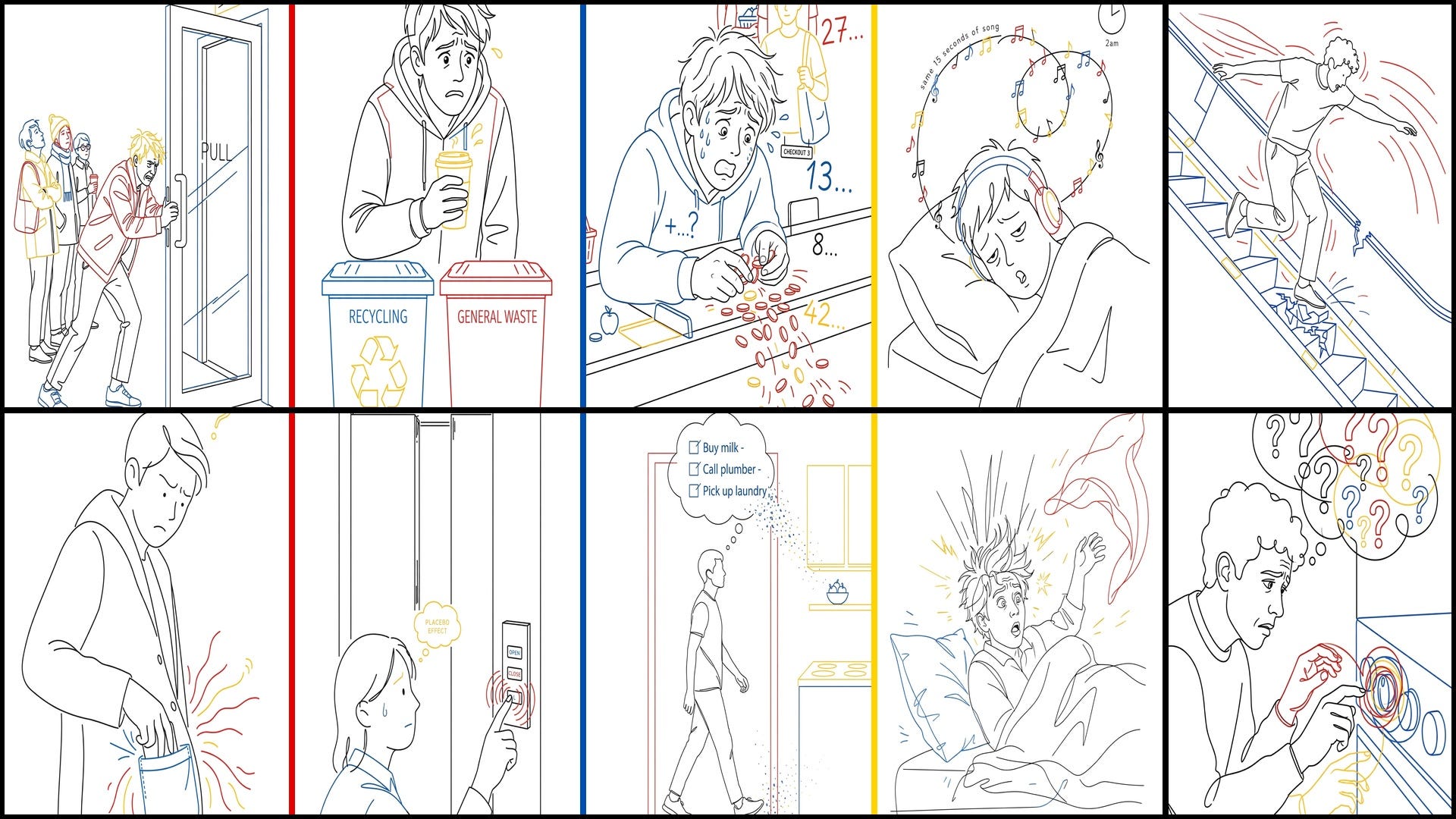
Nobody warns you about this part of adulthood. You spend your twenties collecting real, adult competencies, and your body quietly keeps a separate folder of humiliating micro-failures that have nothing whatsoever to do with how capable you actually are. This essay is about that folder. The good news is that psychologists have been studying almost every item in it for decades. The better news, which took me a while to notice, is that they don’t all have the same explanation. Some of these are your brain’s fault. Several are not your fault at all. And one of them was done to you on purpose.
The Door That Wins Every Time
Let us start with the door. You reach for the handle with total confidence, push, and nothing happens, while a small queue of people watches you attempt violence against a perfectly innocent piece of glass. This has an official name. The designer Don Norman spent decades studying doors that give no visual clue about whether they open by pushing or pulling, and the design world now calls them, a little cruelly, Norman doors. His actual argument is that a door should communicate its own operating instructions through its shape alone. If large numbers of people keep getting the same door wrong, the door failed, not the people. You did not embarrass yourself in front of that café. An architect did, several years ago.
The Doorway That Deletes Your To-Do List
The door itself isn’t the only trouble here. Getting through it successfully comes with its own tax. You walk into the kitchen with a clear, specific reason for being there, cross the threshold, and the reason simply evaporates. Gabriel Radvansky, a psychologist at the University of Notre Dame, has spent years documenting exactly this. His research suggests that doorways act as “event boundaries” in the mind, filing away whatever you were thinking in the previous room the moment you leave it. In his experiments, people were significantly more likely to forget an intention after passing through a doorway than after covering the same distance inside a single room, and walking back to where the thought first occurred doesn’t reliably retrieve it, because the filing has already happened. The doorway effect has replicated widely, but not universally: a 2021 study failed to reproduce it in highly immersive virtual and real environments except when participants were carrying an additional memory load. So the finding is real but conditional, which is roughly what you should expect from any result interesting enough to be worth telling you about. Your brain isn’t losing the plot. It is doing what it does at every transition, occasionally taking your grocery list down with it.
The Bin That Judges You
Once you’re safely inside, a new obstacle appears in the form of two identical-looking bins asking you to make an ethical decision about a coffee cup in under three seconds, ideally without anyone noticing you deliberating. Part of this is design failure again: colour codes that vary by city and sometimes by building, pictograms that could mean anything. But part of it is a separate glitch entirely, and this one is yours. Psychologists call it the spotlight effect. In a landmark study, researchers at Cornell had students wear a deliberately embarrassing T-shirt into a room full of strangers, then asked the wearers to estimate how many people had noticed. The wearers guessed roughly double the real number. Nobody in that café is running a private audit of your recycling ethics. They are almost certainly thinking about their own coffee order, their own commute, their own unrelated bin-shaped anxieties. You are simply not as visible as your nervous system insists you are.
The Cashier Who Accidentally Ruins Your Arithmetic
The spotlight effect explains why you feel watched. It doesn’t explain why you actually get worse at things once you are. That part belongs to Robert Zajonc, who in 1965 pulled together decades of scattered findings into a single theory: an audience raises your general arousal, and arousal strengthens whichever response is already most practised. If the task is simple and well-practised, that helps. Good pool players in the studies he drew on got better under observation, their accuracy climbing from 71 to 80 per cent. If the task is effortful or unfamiliar, the same arousal pushes you towards whatever error is nearest. The poor pool players, watched by the same audience, dropped from 35 to 25 per cent. Counting exact change at a till, with a queue building behind you, sits squarely in the second category. Your arithmetic is not worse than it was five minutes ago in your own kitchen. Your brain is treating being watched as a mild emergency and reaching for the fastest available answer, which is not the same as the correct one.
The Song You Can No Longer Bear
Not every one of these needs a witness. Some you perform entirely alone, at 2 a.m., with the same fifteen seconds of a song looping through your skull uninvited. This is involuntary musical imagery, and researchers at Durham University who study it report that over ninety per cent of people experience it, which makes it the most universal item on this entire list. Now, that is the version that happens to you. What comes next is the version you do to yourself. Because at some point you liked the song enough to play it deliberately, and then played it again, and then forty more times, and somewhere in there it curdled. Psychologists describe this shape as an inverted U. Daniel Berlyne’s account of how liking responds to repeated exposure. Familiarity climbs, peaks, and then, once your brain has fully solved the thing, collapses into irritation. You did not lose your taste in music overnight. You repeated a pleasure past its own expiry date, which is a very human and very forgivable thing to do to a three-minute Punjabi song you will never be able to hear again without wincing.
The Escalator That Still Thinks It’s Moving
Your legs, meanwhile, are running outdated software. Step onto a stationary escalator and your body still braces for motion, producing an odd little stumble even though you can plainly see the steps aren’t moving. The neuroscientists Raymond Reynolds and Adolfo Bronstein documented this properly in 2003, naming it the broken escalator phenomenon, and found that the stumble happens regardless of how certain you are, in the moment, that nothing is about to move. Your legs learned a motor programme from years of ordinary escalators, and that programme fires faster than your conscious brain can countermand it. You are not clumsy. You are simply not the one driving at that particular moment.
The Fall That Wakes You From Nothing
Your motor system pulls the same trick again that night, at the exact moment you’re finally drifting off. You feel yourself falling, jolt awake, and find yourself sitting up in a completely undisturbed bed. This is a hypnic jerk, and sleep researchers estimate it happens to roughly 60 to 70 per cent of people at some point. As your body powers down, the steady low-level signal that keeps your muscles gently tensed all day begins switching off, and every so often a stray burst of activity slips through the handover before the shutdown completes, landing as one single startling contraction. You didn’t nearly fall out of bed. Your nervous system fumbled the light switch on its way out of the room.
The Phone That Isn’t Actually Buzzing
The same overeager prediction machinery shows up in your pocket. You feel your phone vibrate, reach for it, and find that nothing happened at all. A 2012 study of undergraduates found that 89 per cent had experienced this, with a separate study of hospital staff putting the figure near 70 per cent, and in both, almost nobody found it particularly distressing once it was explained to them. Your nervous system has been trained, through thousands of real vibrations, to expect one at any moment, and it occasionally jumps the gun. This is not a symptom of phone addiction so much as pattern recognition working exactly as advertised, just a little trigger-happy.
The Stove You’ve Already Checked Four Times
The same impulse turns up somewhere with higher stakes. You leave the house, reach the end of the street, and turn back to check the stove, even though you’re fairly sure you already did. The psychologist Adam Radomsky ran a study in which ordinary, non-clinical participants repeatedly checked a real kitchen stove, and found something wonderfully counterintuitive. Each additional check made people less confident in their memory of having checked, not more, because repetition makes a memory feel familiar and generic rather than vivid and specific. The fifth check doesn’t reassure you. It hands you a fifth, blurrier memory to distrust. If you’ve ever gone back to check something you were already fairly sure about, that wasn’t paranoia. That was memory behaving exactly as memory behaves under repetition.
The Button You Know Doesn’t Work, and Press Anyway
Which brings us to the last one, and the odd one. Everyone quietly suspects the door-close button in the lift is fake. In most buildings constructed since the early 1990s, it is. When the Americans with Disabilities Act required doors to stay open long enough for anyone using a wheelchair or crutches, the override was largely disconnected. And while that’s American law, the same pattern of decorative buttons turns up elsewhere. In New York, of some three thousand pedestrian crossing buttons, only a small fraction were still wired to anything. Nobody forgot to connect these. Somebody disconnected them, deliberately, and then left the caps on for you to press. Ellen Langer’s work on the illusion of control offers the reason. The button does work. It just doesn’t work on the door. It works on you, lowering your agitation by giving your hands something to do while you wait, which is a real service even if it is a slightly insulting one. You were never foolish for pressing it. You were doing precisely what a well-designed placebo is built to make you do.
The Actual Point
I started this list assuming it had one explanation. It has three, and the difference is the interesting part. Some of these are genuinely your brain. The forgotten intention at the kitchen door, the imagined spotlight in front of the bins, the arithmetic that deserts you at the till, the song that curdles, the stumble on the still escalator, the fall that wakes you from nothing, the buzz that wasn’t there, the fifth blurry memory of the stove. Eight of the ten. All of them come from the same trade: a mind that runs on pattern, prediction and habit, because reasoning from scratch every time would be exhausting and slow, and for most of human history slow got you killed. The occasional false alarm is the overhead fee on an otherwise superb system.
Two of them are not you at all. The door and the bin are objects that failed to explain themselves, and the shame you felt was misdelivered. It belonged to a design decision made years ago by someone who never had to stand in that queue. And one of them, the button, is a third thing entirely. Somebody looked at the gap between what you can control and what you need to feel you control, and quietly built a small machine to close it. You are not malfunctioning there. You are being managed, gently, and it works.
So the next time you shove a pull door, blank on why you walked into the kitchen, hesitate at the bin, panic over coins, sicken of a song you loved, stumble on a stationary escalator, jolt awake mid-fall, reach for a phone that never buzzed, turn back for the stove, or press a button you know is decorative; you can skip the spiral. Somewhere, a psychologist already ran the study, found that essentially everyone does this, and published the paper that lets you off the hook. And where it wasn’t your brain at all, somewhere there is an architect who owes you an apology.
***
This writer once personally lost a wrestling match with a café door in front of her then-future husband. Another time, she pressed an elevator button eleven times in a row while being fully aware that it was doing nothing whatsoever. She considers this a personality trait rather than a design failure, because admitting it is a design failure would mean she has to stop blaming the door and the elevator.